Realistic Crop Rotation V1.0
Realistic Crop Rotation V1.0
Make crop rotation matter.
Every field remembers its last 4 rotation entries, whether crops or fallow years. Plan what returns, watch the disease risk, and protect a sensitive crop before an outbreak destroys part of it.
PLANNING
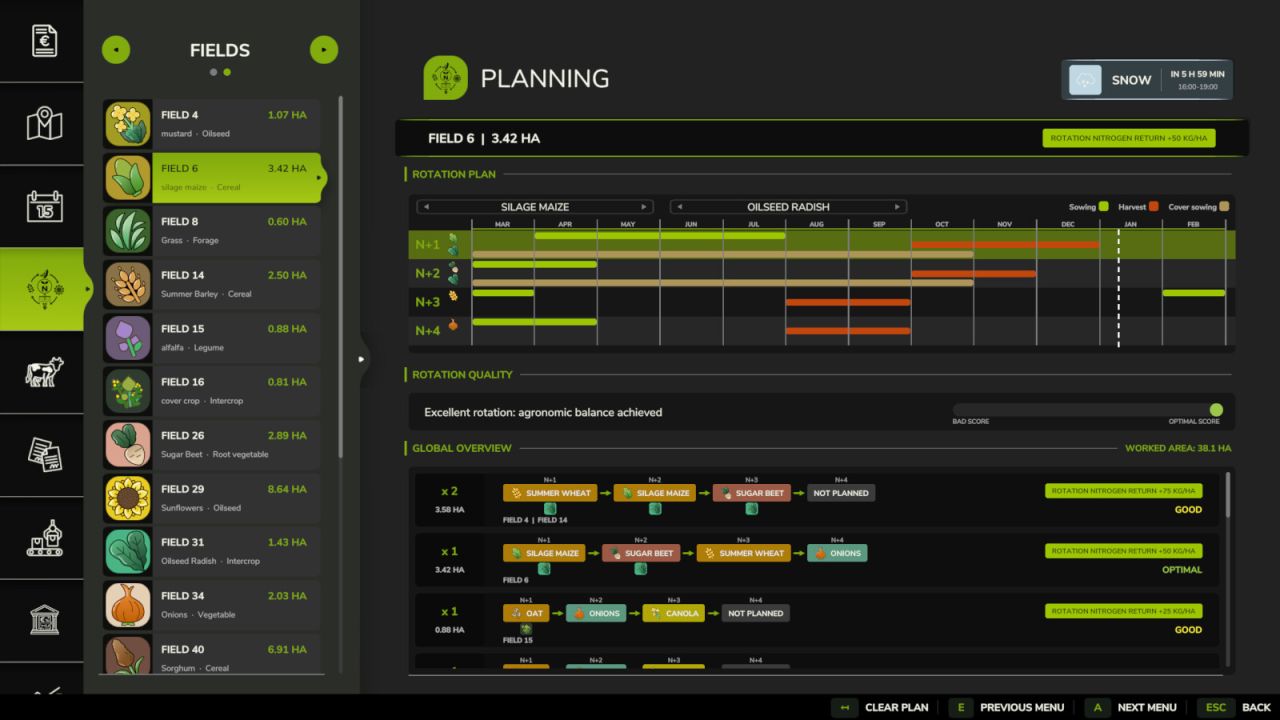
A rotation calendar with a real repeating cycle of 2, 3 or 4 yearly slots, filled with crops or fallow, including the return from the last slot to the first
A planned fallow slot adds one full year of spacing before the next sensitive crop; it does not instantly clear the field or guarantee that every disease has disappeared
A clear rotation quality rating, tailored advice, and conflicts flagged before you sow
Diversity pays: rotate more crops, avoid repeating the same family, and alternate winter and spring sowings
Fields sharing a plan are grouped, with combined area, rotation quality and residue
DISEASES
Nine diseases affect specific crops: sclerotinia, phoma, take-all, septoria, rust, fusarium, late blight, beet cyst nematode and clubroot.
How it works:
A first outbreak can happen even if the field has never been affected. Favourable weather raises the chance for weather-sensitive diseases. Rust and late blight never remain in the field after the crop.
After a real outbreak, sclerotinia, phoma, take-all, septoria, fusarium, beet cyst nematode or clubroot can remain in the field after harvest. The more advanced the outbreak, the greater the risk for a future sensitive crop. A crop that is never infected adds no new disease to the field.
This remaining risk falls once per calendar year. Beet cyst nematode and clubroot can become very weak, but they may remain in the field indefinitely.
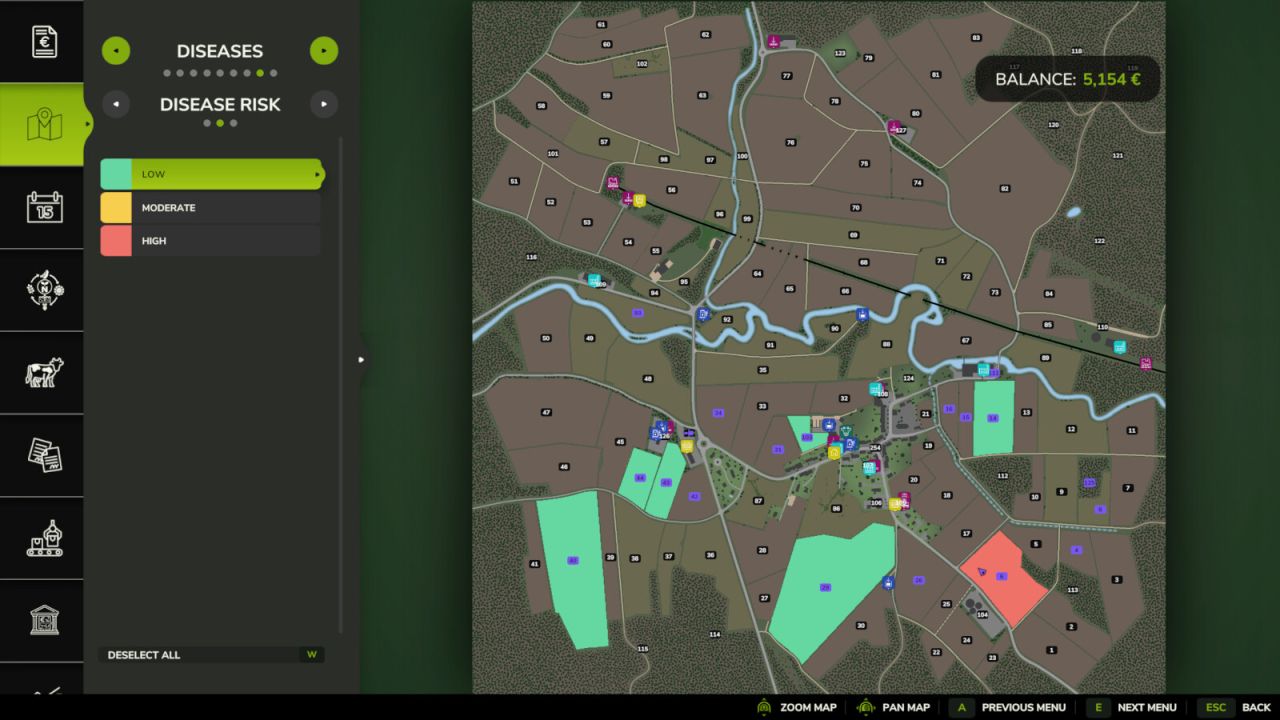
Spacing sensitive crops gives the risk time to fall. The planner warns when a crop returns too soon, and still checks crop-family diversity separately. The Disease Risk map highlights fields where the current crop is more likely to become infected; favourable weather can raise the chance further.
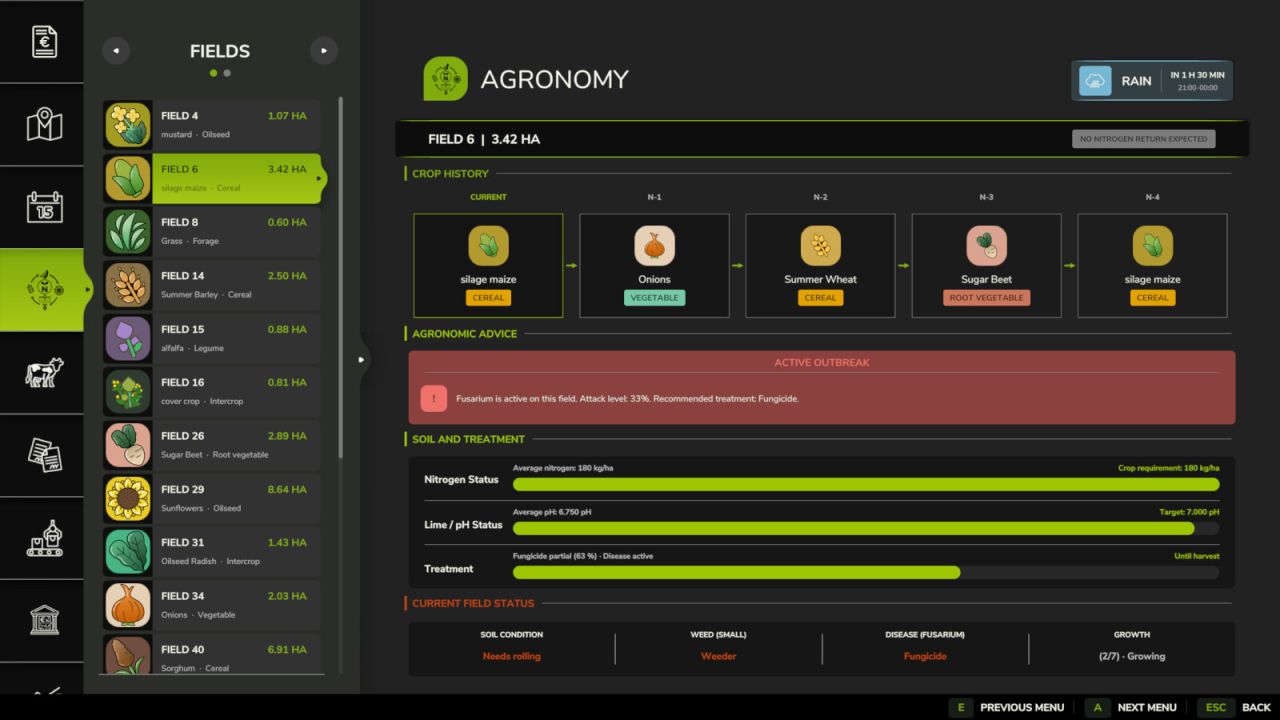
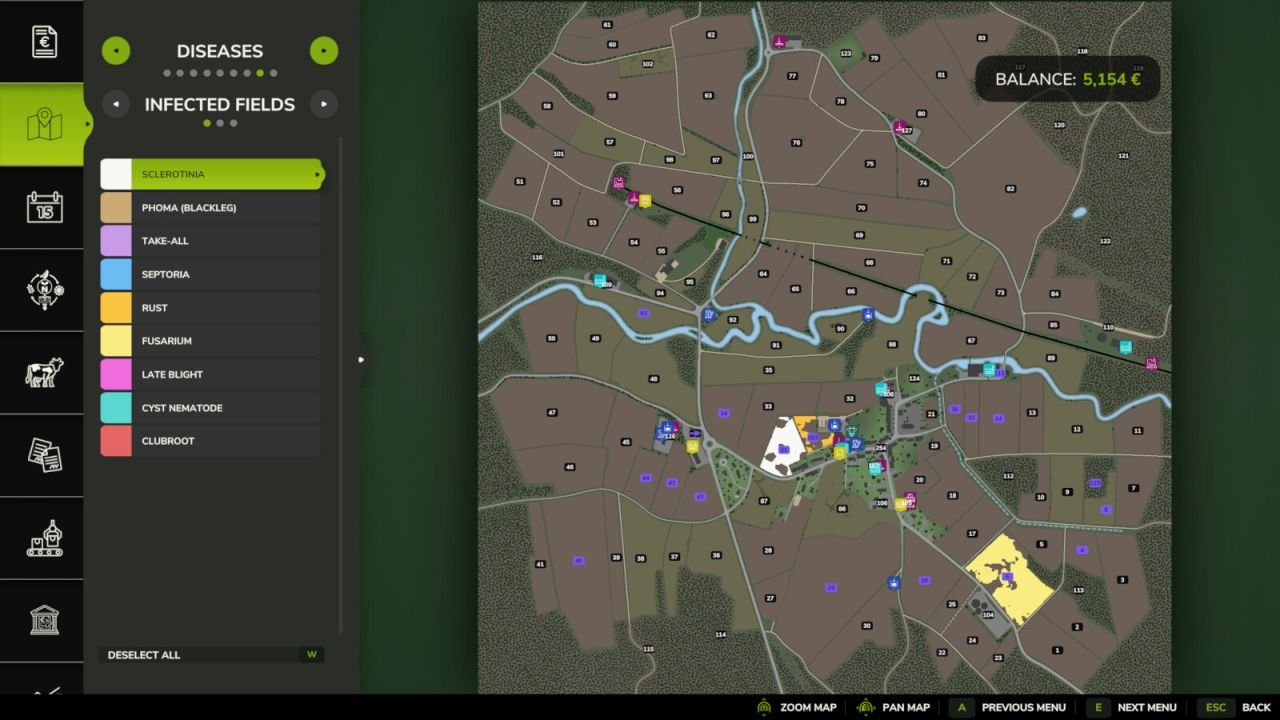
An infection starts at a low attack level and progresses each day. It remains hidden until it begins to damage the crop; before then, only the Disease Risk map and preventive advice show that conditions are favourable. Once damage begins, the outbreak appears on the Infected Fields map, field card and on-foot HUD, and a notification is sent.
TREATMENTS
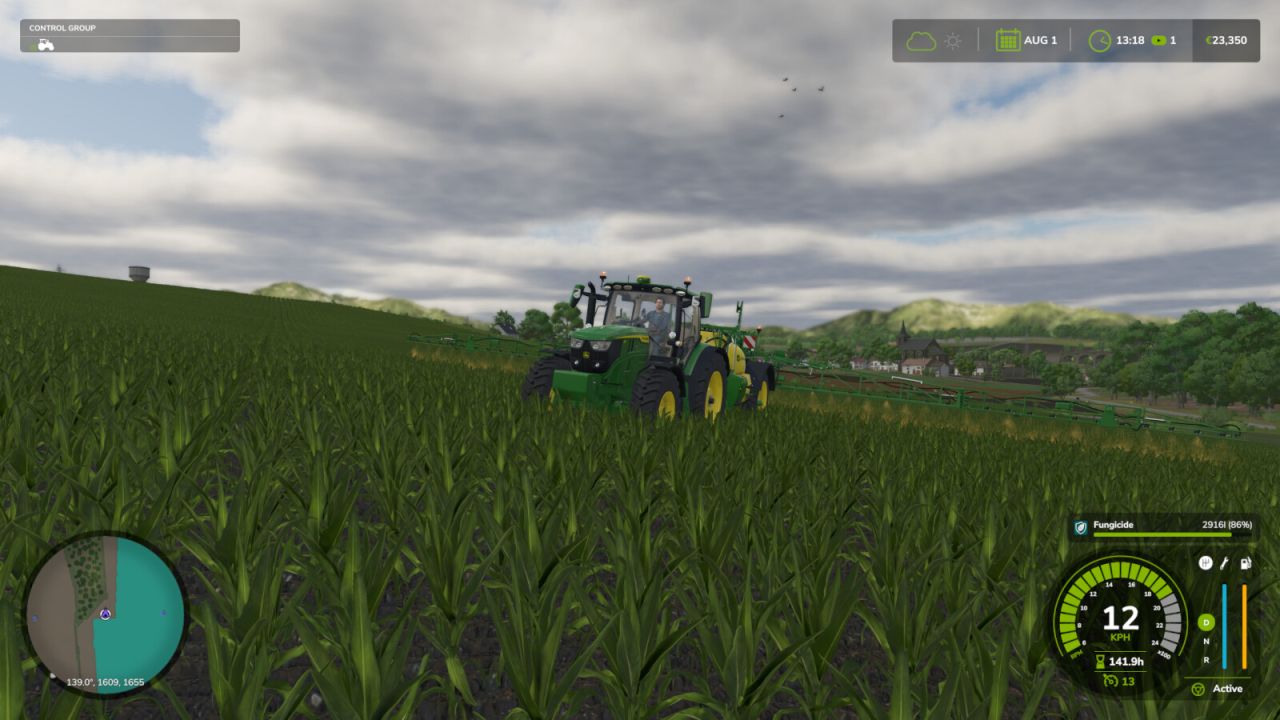
Fungicide AMISTAR (Syngenta) and nematicide VELUM PRIME (Bayer), sprayed with any compatible sprayer.
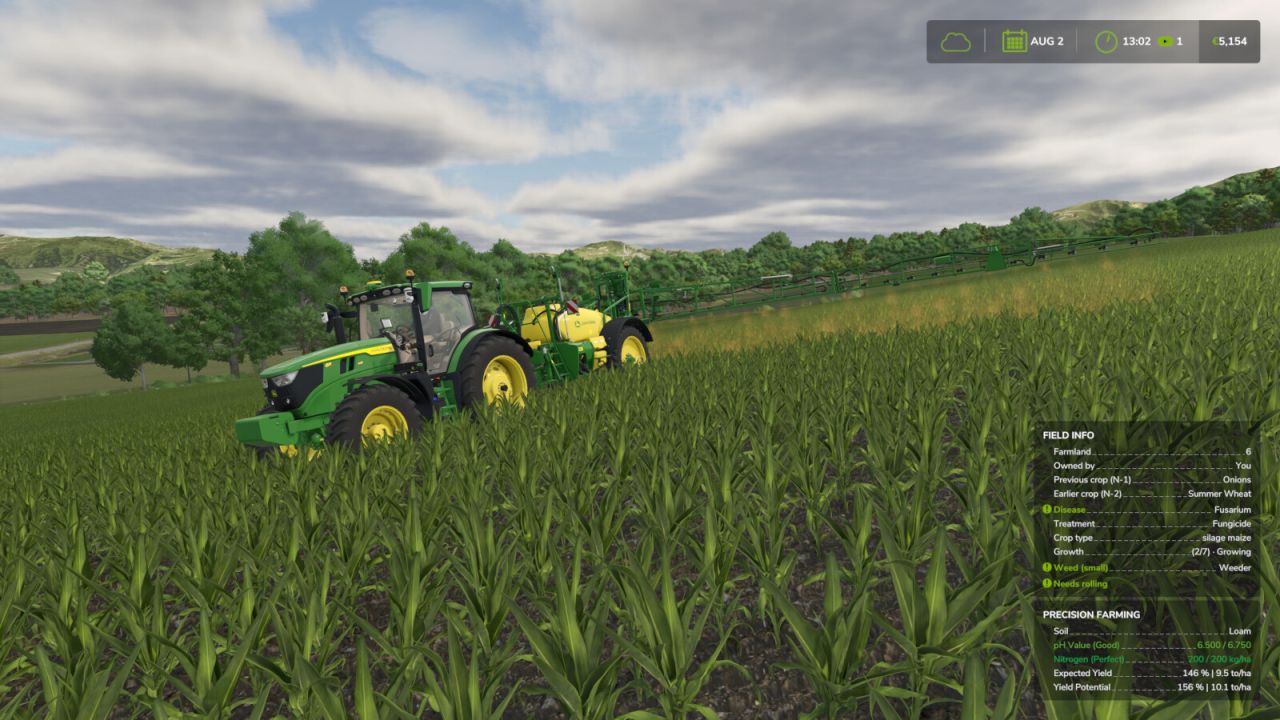
Protection is measured from the share of the field you spray. Fungicide lowers the chance of an outbreak, slows an active disease and protects sprayed crop from destruction. A smaller outbreak leaves less disease behind for future crops, but spraying does not clean a field that is already affected. Nematicide protects sprayed crop from nematode damage but does not remove nematodes from the field. Neither product restores lost crop, so spray early.
Fungicide: used up on the ground you harvest or mow; harvesting ends the active outbreak, but disease may remain for future crops
Nematicide: protects sprayed ground for three months per field; spraying again renews protection without removing nematodes
No product works against take-all or clubroot. Only rotation keeps them down.
NITROGEN RESIDUE
A legume destroyed by tillage, not merely harvested, returns real nitrogen, split between the next crop and the one after. With Precision Farming it lands on the nitrogen map; without it the mod adds one fertilizer level.
In kg N/ha, next crop then the one after: alfalfa 80 then 50, vetch-rye 60 then 20, clover 50 then 20, soybean 40 then 10, pea 40 then 10, green bean 20 then 5. Cover crops count as an estimated +25 in the planner.
IN GAME
A dedicated “Crop Rotation” tab in the menu (ESC)
Three views on the map: infected fields, disease risk, treated ground
Treatment gauge: the share of the field sprayed, the disease status, and how long protection lasts
Field card: current crop, growth stage, required soil work, weeds, detected disease and its treatment, nitrogen, pH
On-foot HUD and a weather header so you can time your spraying
CONSOLE COMMANDS (host or an admin client)
rcrDisease [farmlandId]: prints active disease, remaining field risk and treatment
rcrDiseaseInfect [attackLevel]: forces an infection
rcrDiseaseTick [farmlandId]: runs one cycle, infection roll then progression
rcrDiseaseClear [farmlandId]: clears active disease and any remaining field risk
Valid values: SCLEROTINIA, PHOMA, TAKEALL, SEPTORIA, RUST, FUSARIUM, LATEBLIGHT, BCN, CLUBROOT
Singleplayer and multiplayer, with or without Precision Farming. 27 languages.
Author: Squallqt